NEET Preparation
- NEET UG preparation courses cover all subjects required for the exam, including biology, chemistry, and physics, ensuring thorough preparation for each section of the test.
- Courses are taught by experienced faculty members who specialize in NEET UG preparation, providing students with expert guidance and mentorship throughout their study journey.
- Emphasis is placed on building a strong conceptual foundation in each subject, ensuring students understand the underlying principles and can apply them to solve complex problems.
- Courses provide extensive practice materials, including practice tests, sample questions, and previous years' papers, allowing students to familiarize themselves with the exam format and assess their progress.
- Students are taught effective test-taking strategies, such as time management techniques, question-solving approaches, and elimination methods, to optimize their performance on exam day.
- Courses incorporate regular assessments, quizzes, and mock tests to track students' progress, identify areas of improvement, and provide targeted feedback for further study.
- Dedicated doubt resolution sessions are offered to address students' queries and clarify concepts, ensuring that no doubts or misconceptions are left unresolved.
- Courses may include exam simulation sessions to simulate the NEET UG testing environment, helping students familiarize themselves with the exam conditions and reduce test anxiety.
- NEET UG preparation courses not only focus on academic content but also emphasize overall student well-being, providing support services such as counseling, stress management techniques, and motivational sessions to ensure students are mentally and emotionally prepared for the exam.
NEET 2024 Exam Pattern – NEET Syllabus
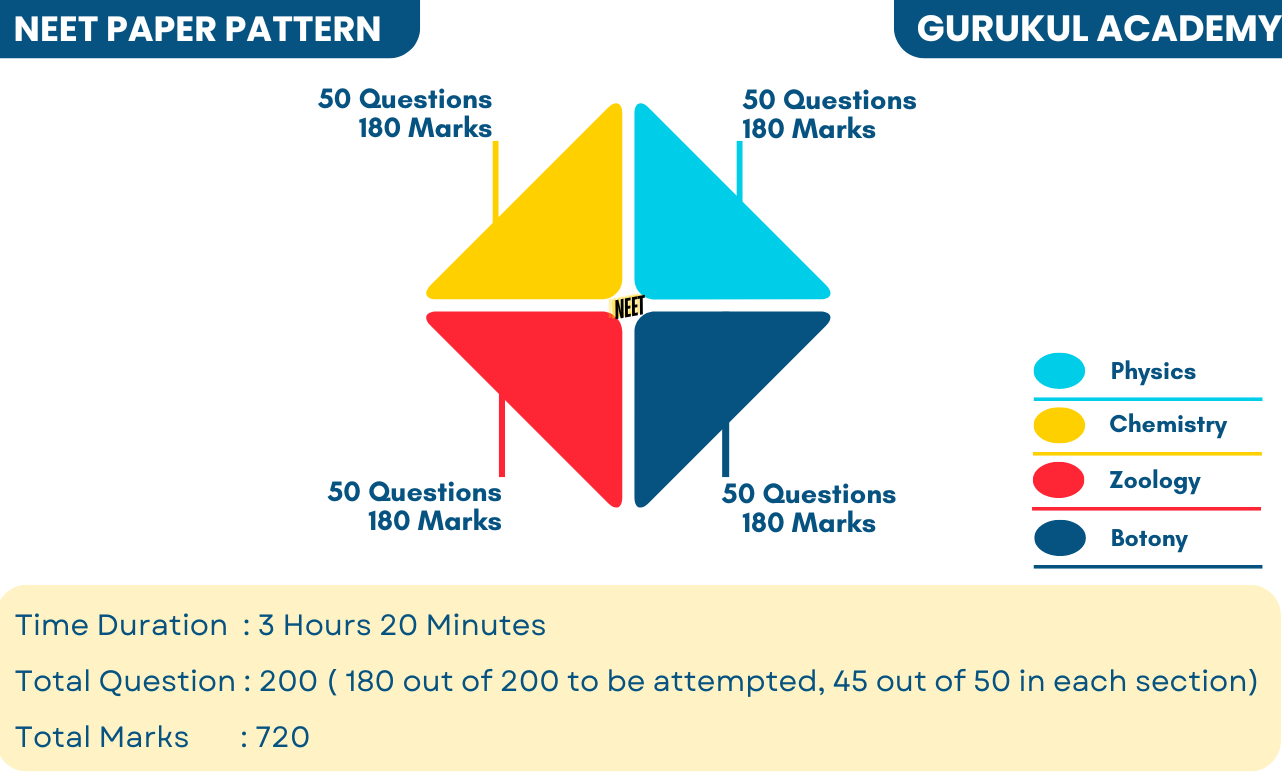
The exam pattern for NEET 2024 has two sections. Each of the subjects has 2 sections –
- Section A – 35 Questions
- Section B – 15 Questions
All 35 questions of section A must be answered in each subject. Out of these 15 questions appearing in section B, candidates can attempt any 10 of these questions. Hence, the total number of questions remains the same.
NEET Full Syllabus 2024 (Revised)
Physics Syllabus for NEET 2024
Usually, students find the Physics section of NEET to be challenging of all, given the questions involve computations and the application of theoretical knowledge to answer questions. The table below provides a brief of all the chapters from class 11 and class 12 included in the NEET exam syllabus as per the NTA.
NEET Physics Syllabus 2024
|
Class 11th Syllabus |
Class 12th Syllabus |
|---|---|
| Physical world and measurement | Electro statistics |
| Kinematics | Current Electricity |
| Laws of Motion | Magnetic effects of Current and Magnetism |
| Work, Energy, and Power | Electromagnetic induction and alternating currents |
| Motion of systems of particles and rigid body | Electromagnetic waves |
| Gravitation | Optics |
| Properties of Bulk Matter | Dual Nature of Matter and Radiation |
| Thermodynamics | Atoms and Nuclei |
| Behaviour of Perfect Gas and Kinetic theory | Electronic Devices |
| Oscillations and wave |
Chemistry Syllabus for NEET 2024
The Chemistry section of NEET is considered to be the scoring section, most questions are NCERT-based and direct in nature. Usually, the questions in NEET from chemistry are easy to understand and answer. Tabulated below is the NEET syllabus for Chemistry from class 11 and class 12.
NEET Chemistry Syllabus 2024
| Class 11th Syllabus | Class 12th Syllabus |
| Some basic concepts of Chemistry | Solid state |
| Structure of atom | Solutions |
| Classification of Elements and Periodicity in Properties | Electrochemistry |
| Chemical Bonding and Molecular structure | Chemical Kinetics |
| States of Matter: Gases and liquids | Surface Chemistry |
| Thermodynamics | General principles and Processes of Isolation of Elements |
| Equilibrium | P Block elements |
| Redox reactions | D and F block elements |
| Hydrogen | Coordination compounds |
| s-Block elements (Alkali and Alkaline earth metals) | Haloalkanes and Haloarenes |
| Some p-Block elements | Alcohols, Phenols, and Ethers |
| Organic Chemistry – Some basic principles and techniques | Aldehydes, Ketones and Carboxylic Acids |
| Hydrocarbons | Organic compounds containing Nitrogen |
| Environmental chemistry | Biomolecules, Polymers, and Chemistry in everyday life |
NEET Syllabus 2024 Biology
The Biology section of NEET comprises the most number of questions, 90 questions out of a total of 180 questions, given the vast syllabus it covers from Botany and Zoology. Since there are many chapters to cover in Biology syllabus for NEET 2024, it is highly recommended to follow the syllabus provided in the following table while NEET preparation as prescribed by the NTA.
NEET 2024 Biology Syllabus
| Class 11th Syllabus | Class 12th Syllabus |
| Diversity in the Living World | Reproduction |
| Structural organisation – Plants and Animals | Genetics and Evolution |
| Cell Structure and Function | Biology and Human welfare |
| Plant Physiology | Biotechnology and its applications |
| Human physiology | Ecology and environment |
Important Topics For NEET – NEET Syllabus Analysis Chapter-wise Weightage
NEET Physics Syllabus Analysis – NEET Chapter-wise Weightage
NEET 2021 Question Paper Analysis – Physics
| Chapters | Questions Breakup |
| Modern Physics & Electronics | 8 |
| Magnetism | 7 |
| SHM & Wave | 3 |
| Optics | 4 |
| Electrostatics and Electricity | 11 |
| Heat & Thermodynamics | 4 |
| Mechanics | 13 |
NEET 2020 Question Paper Analysis – Physics
The table below depicts the weightage of topics in the NEET Syllabus Physics Section, provided unit-wise after analysis of NEET 2020 question paper. Take a look:
| Unit | Weightage (approximate) |
| Physical World and Measurement | 2% |
| Kinematics | 7% |
| Laws of Motion | 7% |
| Work, Energy and Power | 4% |
| System of Particles and Rotational Motion | 4.50% |
| Gravitation | 4.50% |
| Properties of Bulk Matter | 9% |
| Oscillations and Waves | 7% |
| Thermodynamics | 4.50% |
| Behaviour of Perfect Gas and Kinetic Theory | 2% |
| Electrostatics | 4% |
| Current Electricity | 9% |
| Magnetic Effects of Current and Magnetism | 7% |
| Electromagnetic Induction and Alternating Currents | 4% |
| Electromagnetic Waves | 2% |
| Optics | 4.50% |
| Dual Nature of Radiation and Matter | 4% |
| Atoms and Nuclei | 7% |
| Electronic Devices | 7% |
NEET Chemistry Syllabus Analysis – NEET Syllabus 2024 Topic-wise
NEET 2021 Question Paper Analysis – Chemistry: NEET Chapter-wise Weightage
| Chemistry Sections | Questions Breakup |
| Inorganic Chemistry | 19 |
| Organic Chemistry | 15 |
| Physical Chemistry | 16 |
A detailed breakup of the number of questions for each chapter of NEET Chemistry 2021 is as follows –
| Physical Chemistry | |
| Chapter | No. of Questions |
| Solid state | 2 |
| States of matter | 2 |
| Thermodynamics | 1 |
| Electrochemistry | 2 |
| Surface chemistry | 1 |
| Solutions | 2 |
| Chemical Kinetics | 2 |
| Nuclear Chemistry | 1 |
| Mole concept | 1 |
| Atomic structure | 1 |
| Ionic equilibrium | 1 |
| Inorganic Chemistry | |
| Chapter | No. of Questions |
| Chemical Bonding | 5 |
| s-block | 2 |
| p-block | 3 |
| d and f block | 2 |
| Metallurgy | 2 |
| Environmental chemistry | 1 |
| Coordination chemistry | 2 |
| Organic Chemistry | |
| Chapter | No. of Questions |
| Some basic principles and techniques | 1 |
| Hydrocarbons | 4 |
| Haloalkanes and Haloarenes | 2 |
| Alcohol, Phenol and Ether | 1 |
| Carbonyl compound | 3 |
| Amine | 2 |
| Biomolecules | 1 |
| Polymers | 1 |
| Chemistry in Everyday Life | 1 |
NEET 2020 Question Paper Analysis – Chemistry
The table below depicts the weightage of topics covered in the NEET Chemistry Section (Physical, Inorganic and Organic chemistry), provided unit-wise after analysis of NEET 2020 question paper. Take a look:
| Class | Chemistry Section | Name of unit |
Weightage (approximate)
|
|
Class 11
|
Inorganic Chemistry
|
Hydrogen |
13%
|
| s-Block Element (Alkali and Alkaline earth metals) | |||
| Some p-Block Elements | |||
| Chemical Bonding and Molecular Structure | |||
| Classification of Elements and Periodicity in Properties | |||
|
Organic Chemistry
|
Environmental Chemistry |
11%
|
|
| Organic Chemistry- Some Basic Principles and Techniques | |||
| Hydrocarbons | |||
|
Physical Chemistry
|
Some Basic Concepts of Chemistry |
22%
|
|
| Structure of Atom | |||
| States of Matter: Gases and Liquids | |||
| Thermodynamics | |||
| Equilibrium | |||
| Redox Reactions | |||
|
Class 12
|
Inorganic Chemistry
|
General Principles and Processes of Isolation of Elements |
16%
|
| p- Block Elements | |||
| d and f Block Elements | |||
| Coordination Compounds | |||
|
Organic Chemistry
|
Haloalkanes and Haloarenes |
22%
|
|
| Alcohols, Phenols and Ethers | |||
| Aldehydes, Ketones and Carboxylic Acids | |||
| Organic Compounds Containing Nitrogen | |||
| Biomolecules | |||
| Polymers | |||
| Chemistry in Everyday Life | |||
|
Physical Chemistry
|
Solid State |
16%
|
|
| Solutions | |||
| Electrochemistry | |||
| Chemical Kinetics | |||
| Surface Chemistry |
NEET Biology Syllabus Analysis – NEET Syllabus 2024 Topic-wise
NEET 2021 Question Paper Analysis – Biology: NEET Chapter-wise Weightage
| Chapter | No. of Questions |
| The Living World | 1 |
| Biological Classification | 1 |
| Plant Kingdom | 5 |
| Animal Kingdom | 4 |
| Morphology of Flowering Plants | 2 |
| Anatomy of Flowering Plants | 3 |
| Structural Organisation in Animals | 3 |
| Cell: The Unit of Life | 2 |
| Biomolecules | 3 |
| Cell Cycle and Cell Division | 7 |
| Transport in Plants | 1 |
| Photosynthesis in Higher Plants | 4 |
| Respiration in Plants | 1 |
| Plant Growth and Development | 3 |
| Digestion and Absorption | 2 |
| Breathing and Exchange of Gases | 3 |
| Body Fluids and Circulation | 3 |
| Locomotion and Movement | 4 |
| Sexual Reproduction in Flowering plants | 3 |
| Human Reproduction | 3 |
| Reproductive Health | 3 |
| Principles of Inheritance and Variation | 2 |
| Molecular Basis of Inheritance | 10 |
| Evolution | 1 |
| Human Health and Disease | 3 |
| Strategies for Enhancement in Food Production | 3 |
| Microbes in Human Welfare | 1 |
| Biotechnology: Principles and Processes | 6 |
| Biotechnology and its Applications | 5 |
| Organisms and Populations | 4 |
| Ecosystem | 3 |
| Environmental Issues | 1 |
NEET 2020 Question Paper Analysis – Biology
On the basis of NEET 2020 question paper, analysis of the NEET exam biology section reveals the following details.
NEET Biology – Weightage of various topics is as follows:
| Class XI | ||
| Unit | Chapters | Weightage (approximate) |
| I | Diversity of Living Organisms | 12% |
| II | Structural Organisation in Plants & Animals | 9% |
| III | Cell: Structure and Function | 8% |
| IV | Plant Physiology | 8% |
| V | Human Physiology | 16% |
| Class XII | ||
| Unit | Chapters | Weightage |
| VI | Reproduction | 11% |
| VII | Genetics and Evolution | 13% |
| VIII | Biology and Human Welfare | 9% |
| IX | Biotechnology and its Applications | 4% |
| X | Ecology and Environment | 10% |
NEET Previous Years’ Question Papers Analysis – NEET 2024 Syllabus
Best Books For NEET Preparation
Best Books for NEET Physics Preparation – NEET Syllabus Physics
| Concepts of Physics by H. C. Verma |
| NCERT (Textbook) Physics – Class 11 & 12 |
| D. C. Pandey Objective Physics |
| Fundamentals of Physics by Halliday, Resnick, and Walker |
| Problems in General Physics by I. E. Irodov |
Best Books for NEET Chemistry Preparation – NEET Syllabus Chemistry
| NCERT (Textbook) Chemistry |
| Physical Chemistry by O. P. Tandon |
| Organic Chemistry by Morrison and Boyd |
| Modern ABC for Chemistry for Class 11 & 12 |
| Concise Inorganic Chemistry by J. D. Lee |
| Chemistry by Dinesh |
Best Books for NEET Biology Preparation – NEET Syllabus Biology
| NCERT (Textbook) Biology for Class 11 & 12 |
| Trueman’s Biology – Volume 1 & Volume 2 |
| Objective Biology – Dinesh |
| Biology by Pradeep’s Publications |
| Biology by GRB Bathla’s Publications |
Advantages Of Using NEET Syllabus 2024 For NEET Preparation
NEET syllabus is vital in preparation to perform exceedingly well. Students often tend to ignore important topics covered in the syllabus since they give a miss to refer to the syllabus prescribed by the NTA for NEET and hence are unable to answer such questions if they appear in the examination.
With a detailed syllabus in hand, candidates can interlink concepts and study, which is a good tactic for sound preparation in addition to the clarity of concepts. It only helps build concepts that are crucial for NEET. Experts with years of experience and even NEET toppers over the years highlight the importance of syllabus and credit an in-depth understanding of the syllabus to their performance.